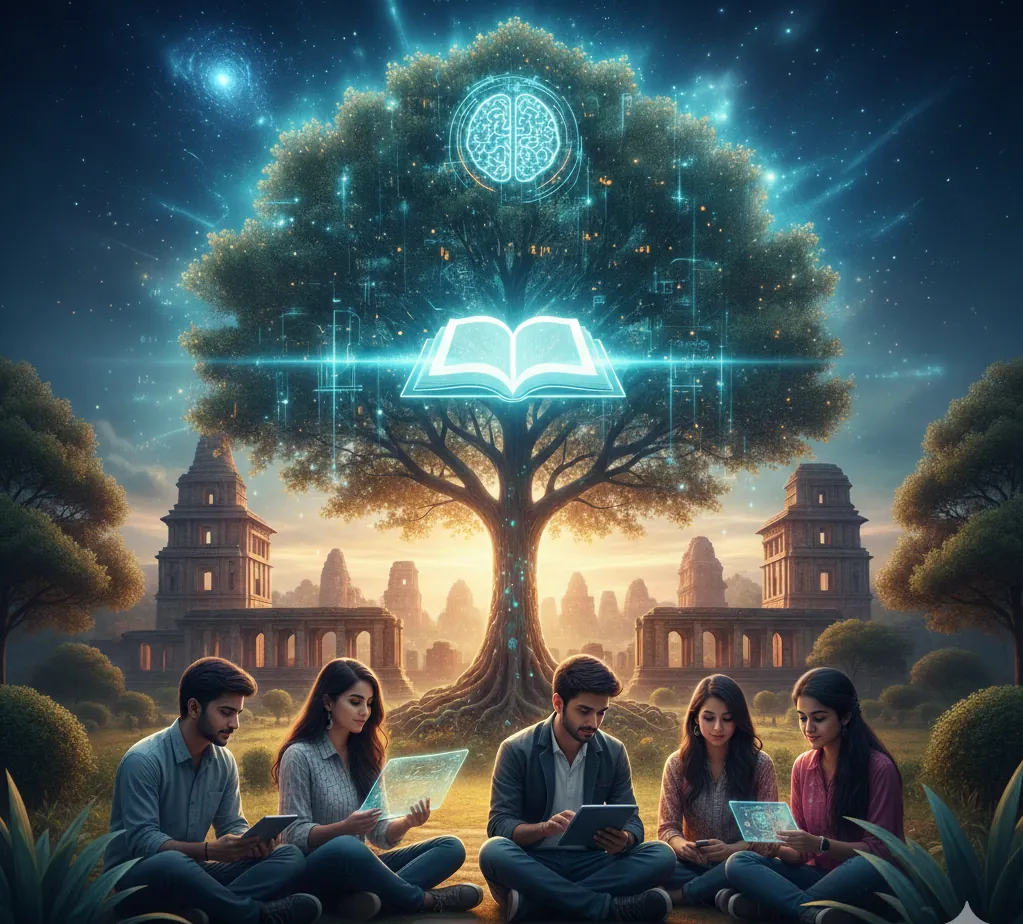
In the journey of building India's future, education stands as our most powerful tool. However, we find ourselves at a critical crossroads. Despite gaining independence in 1947, many of our systems remain mentally tethered to a colonial past, prioritizing foreign linguistic styles over our own cultural logic. It is time we redefine what "true education" actually looks like.
The Limitation of "Syllabus-Only" Knowledge
Today’s education system has largely become a game of memory rather than mastery. From preschool through graduation, students spend 15 years within a rigid framework, consuming textbooks just to pass examinations.
But can we truly call this education? Historically, India was never a "poor" nation. Our strength lay in our decentralized learning systems and a deep-rooted sense of humanity. When our native methods were dismantled and replaced by a standardized "industrial" method, we lost the spark of individual genius.
Nalanda: A Legacy of Intellectual Freedom
If we look back at the Nalanda University model, we see a system that was centuries ahead of its time. It wasn't a place for rote memorization; it was a sanctuary for dialogue.
- Experiential Learning: At Nalanda, the study of botany didn't happen in a closed room; it happened in nature.
- Student-Centric: A student’s journey was dictated by their curiosity, not a fixed schedule.
- The Guru-Shishya Dynamic: Education was a living conversation between a mentor and a seeker.
The Mathematics of Curiosity
As an engineer, I view learning through the lens of Efficiency. When is the "Optimal Acquisition Time" for knowledge? It is the exact moment a student becomes eager or curious.
- If you force-feed data into a mind that isn't asking questions, the "retention rate" is near zero.
- If you provide knowledge when a student is hungry for an answer, the learning is permanent.
True education should not be a "one-size-fits-all" product. Every mind is a different system with different input requirements.
Forging a New Path
To move from "Average" to "Extraordinary," we must reintegrate our heritage with modern technology:
- Research-Driven Minds: We must encourage students to investigate why things work, rather than just how to pass the test.
- Cultural Anchor: Our values shouldn't be a separate subject; they should be the foundation of our logic.
- Global Competence: By mastering our own systems first, we can contribute original research to the global stage, reclaiming our role as a "Vishwa Guru" (World Leader).
Education is more than a degree; it is the process of turning a human into a refined instrument of progress.